
If you’ve been researching retirement planning, you’ve probably come across annuities—and just as quickly felt overwhelmed.
Between the different types, industry jargon, and conflicting opinions, it’s not always clear what’s actually right for you. The reality is, understanding how to choose the best annuity for retirement doesn’t have to be complicated. You just need a simple framework.
In this guide, we’ll walk through how annuities work, what a fixed indexed annuity is, and how to decide which type fits your retirement goals.
What Is an Annuity?
An annuity is a contract with an insurance company designed to provide either guaranteed income or tax-deferred growth.
There are two main phases.
The first is the accumulation phase. This is when you contribute money and allow it to grow over time.
The second is the payout phase. This is when you begin receiving income, either for a set number of years or for the rest of your life.
Annuities are not a one-size-fits-all solution. The best annuity for retirement depends on what you want your money to do.
Read our deeper breakdown of how annuities create long-term income and stability.
How Do Annuities Work?
Understanding how annuities work is easier when you break it into three simple steps.
First, you contribute money. This can be a lump sum, ongoing payments, or funds rolled over from a retirement account like a 401(k) or IRA.
Second, your money grows. One of the biggest advantages is tax-deferred growth, meaning you don’t pay taxes until you withdraw the money. How it grows depends on the type of annuity.
Third, you turn it into income. You can choose to receive guaranteed payments for life, for a specific time period, or take flexible withdrawals.
Types of Annuities Explained Simply
Fixed Annuities
Fixed annuities offer a guaranteed interest rate for a set period of time. Your principal is protected, and growth is predictable.
These are typically best for people who want stability and are not comfortable with market risk.
Variable Annuities
Variable annuities allow you to invest in market-based subaccounts. This gives you higher growth potential, but also exposes you to market losses and typically higher fees.
These are better suited for individuals who are comfortable with volatility and long-term market investing.
What Is a Fixed Indexed Annuity?
A fixed indexed annuity is a type of annuity that links your potential growth to a market index, such as the S&P 500, while still protecting your principal from market losses.
It’s important to understand that you are not directly invested in the market. Instead, the insurance company uses a formula to determine how much interest is credited.
These formulas often include caps, participation rates, and spreads, which affect how much of the market gain you receive.
This type of annuity is often a good fit for people who want more growth potential than a fixed annuity, but without the downside risk of the market.
How to Choose the Best Annuity for Retirement
Choosing the right annuity starts with clarity around your goals.
Step 1 – Define the Purpose
Ask yourself what role you want the annuity to play.
Do you want to create a reliable monthly income stream?
Are you trying to protect your savings from market loss?
Do you want tax-deferred growth for future income?
Your answer will guide everything else.
Step 2 – Decide When You Need Income
If you need income now or within the next couple of years, an immediate annuity may make sense.
If you’re planning for income later in retirement, a deferred annuity—such as a fixed or fixed indexed annuity—can help you grow your money first.
Step 3 – Be Honest About Risk
Your comfort level with risk is a key factor.
If market swings make you uneasy, fixed annuities may be a better fit.
If you want some growth potential without losing principal, fixed indexed annuities are worth considering.
If you are comfortable with risk and want higher potential returns, variable annuities may be appropriate.
Step 4 – Consider Flexibility
It’s important to understand how accessible your money will be.
Some annuities have surrender periods and limits on withdrawals. Because of this, it’s usually best to only allocate a portion of your retirement savings to annuities.
Common Mistakes to Avoid
One common mistake is choosing an annuity based solely on the highest advertised rate or bonus. These offers can be appealing, but they don’t always tell the full story.
Another mistake is ignoring fees, surrender charges, or optional rider costs. These can impact your long-term results.
Some people also put too much of their retirement savings into annuities, limiting their flexibility.
Others fail to align their annuity decision with their overall retirement plan, including taxes and other income sources.
Finally, not researching the insurance company’s financial strength can lead to unnecessary risk.
A better approach is to focus on how the annuity fits into your overall strategy, not just the product itself.
Fixed vs Fixed Indexed vs Variable Annuities
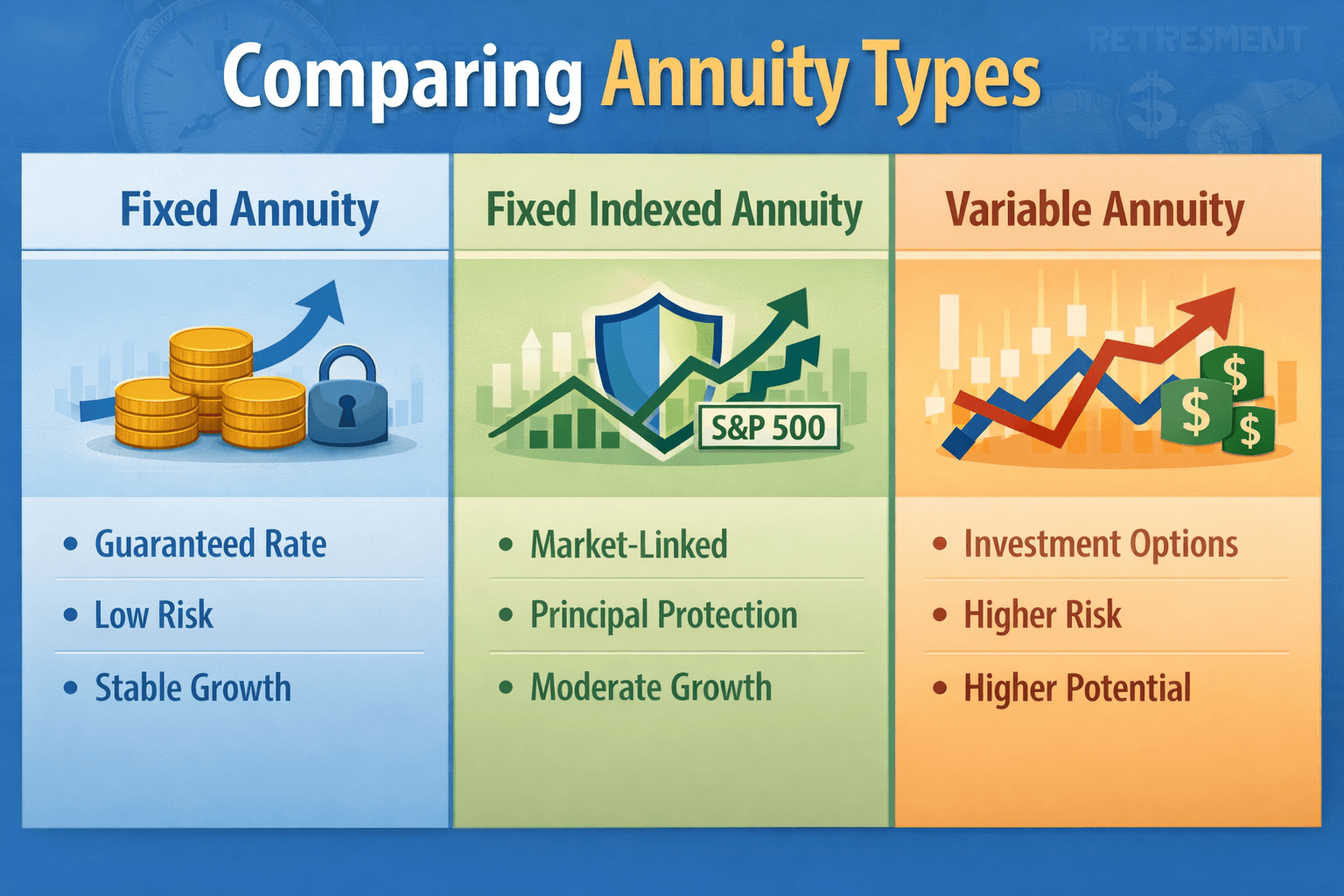
Fixed annuities offer low risk, predictable growth, and full principal protection. They are best for conservative savers.
Fixed indexed annuities provide moderate growth potential tied to a market index, with protection from losses. They are ideal for those seeking balance between growth and safety.
Variable annuities offer higher growth potential but come with market risk and no principal protection. They are best suited for growth-oriented investors.
When an Annuity May Not Be Right for You
Annuities are not always the best option.
If you need access to your money in the short term, require high liquidity, or are working with a smaller amount of savings, other strategies may be more appropriate.
This is why personalized guidance is so important.
Additional Resources on Annuities
For more information on annuities and retirement planning, you can explore these trusted resources:
Next Steps
If you’re trying to figure out how to choose the best annuity for retirement, the most important step is understanding your own situation.
Start by identifying your current income sources and any gaps in your retirement plan. Then decide how much guaranteed income you want versus how much flexibility you need.
From there, it helps to speak with a professional who can walk you through your options.
ICT Insurance Group works with individuals and families across multiple states to simplify retirement planning and provide personalized guidance on annuities, life insurance, and Medicare.
If you’d like help exploring your options, the first step is understanding how annuities fit into your overall retirement plan.
You can learn more about your annuity options at here.
Or speak directly with an agent at ICT Insurance Group by calling (316) 440-6111 for personalized guidance.